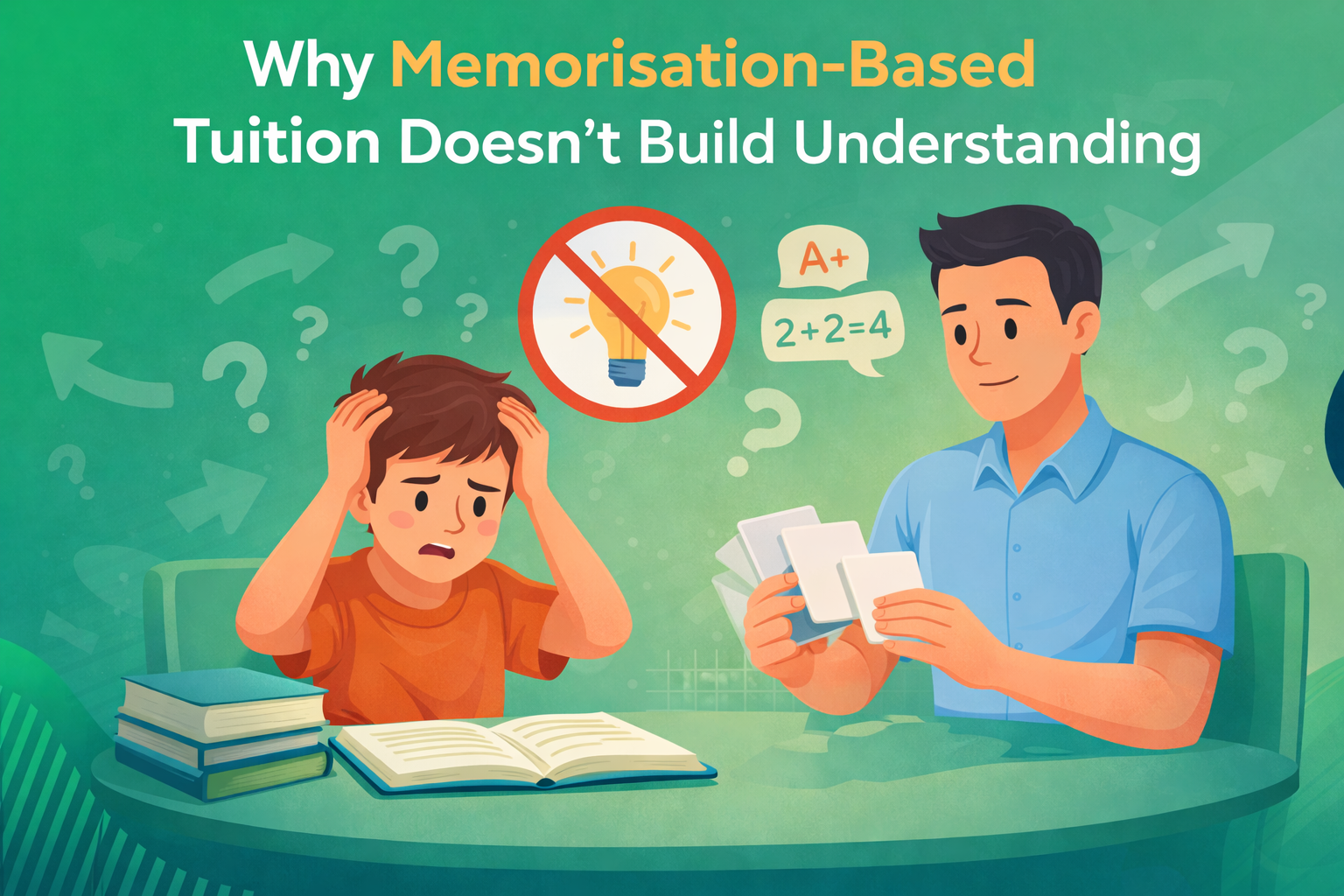
Why Memorisation-Based Tuition Doesn’t Build Understanding
Memorisation-based tuition teaches children how to repeat, not how to think. It fills notebooks, finishes homework, and produces answers that look correct until the moment a question changes its shape. Nothing has been understood, only stored briefly and forgotten just as quickly. There is no sense of why, no internal logic, no thread connecting one idea to another.
So when learning demands reasoning instead of recall, the mind has nothing to hold on to. What remains is silence, confusion, and the quiet realisation that remembering was never the same as knowing.
The Problem You’re Probably Facing
Your child’s tuition teacher says everything is going great.
Homework’s done. Test scores look good. Everyone seems happy.
Then the school exam happens.
Question format changes slightly.
Your child freezes.
They know they’ve “studied” this topic. They remember practicing similar problems. But this one looks… different.
Blank paper. Panic. Poor marks.
You’re confused. They attended every tuition class. Completed every assignment. Scored well in tuition tests.
What went wrong?
Here’s the truth: Your child memorized. They didn’t understand.
And there’s a massive difference between the two.
Memorization vs Understanding: What’s the Real Difference?
Let’s be clear about what we mean.
Memorization Is:
- Storing information temporarily without context
- Focusing on what to do, not why it works
- Reproducing exact steps from practice problems
- Forgetting everything within weeks of exams
- Helpless when problem format changes
Understanding Is:
- Grasping underlying principles and logic
- Knowing why formulas work and when to use them
- Applying concepts flexibly to completely new situations
- Retaining knowledge for years, not weeks
- Solving problems you’ve never seen before
Example:
Memorization: “When you see a² + b², remember c² formula and plug in numbers.”
Understanding: “The Pythagorean theorem describes the relationship between sides of a right triangle because… [can explain with logic and diagrams].”
One gets you marks on predictable tests.
The other gets you actual knowledge.
Why Tuition Centers Push Memorization (It’s Not About Your Child)
Before you blame your child or their tutor, understand this:
Memorization-based teaching isn’t an accident. It’s a business strategy.
1. It’s Faster and Cheaper
Explaining why concepts work takes time.
Teaching derivations requires skill.
Building understanding needs small groups and personal attention.
But giving students a formula sheet and pattern list?
That’s quick. Scalable. Cheap.
Tuition centers can pack 30 students in a room, hand out shortcut tricks, and call it teaching.
2. It Shows Quick Results Parents Want
You want to see your child’s grades improve.
Tuition centers know this.
Memorization delivers fast wins:
- Good scores on tuition’s internal tests
- Quick homework completion
- Confident answers to practiced problems
Parents see improvement. They’re happy. They pay.
Nobody realizes the foundation is built on sand.
3. The Exam System Rewards It (Sometimes)
Many school tests are pattern-based.
Same question types. Predictable formats. Standard marking schemes.
Students who’ve memorized patterns score well.
The system accidentally rewards memorization over understanding.
Until it doesn’t. (Hello, competitive exams.)
How to Tell If Your Child Is Memorizing Instead of Understanding
You don’t need to be a teacher to spot this.
Watch for these signs:
Academic Red Flags:
They can solve practice problems but crash on variations. If the question is exactly like homework, perfect. Change one word, blank stare.
They forget everything after exams. Real understanding sticks. Memorization vanishes within weeks.
They can’t explain concepts in their own words. Ask them to teach you the concept. If they can only repeat textbook definitions, it’s memorization.
They need to see a similar example to solve anything. Can’t think independently. Always asking “show me one like this.”
They struggle when the question format changes. The question says “calculate” instead of “find”? Confused.
Behavioral Signs:
They ask “which formula” not “why does this work.” Focused on what to memorize, not what to understand.
They panic when facing unfamiliar problems. No problem-solving skills. Just pattern-matching skills.
They can’t connect concepts across topics. Everything exists in isolated boxes in their brain.
Sound familiar?
That’s memorization-based learning in action.
The Science: Why Memorization Fails Your Child’s Brain
Here’s what actually happens in your child’s brain when they memorize vs understand:
Memorization = Shallow Processing
Information goes into short-term memory.
Brain treats it as temporary data (like remembering a phone number long enough to dial).
No deep neural pathways formed.
No lasting change in brain structure.
Result? Forgotten within days or weeks.
Understanding = Deep Processing
Concepts integrate with existing knowledge.
Brain builds mental frameworks (called “schemas”).
Strong neural connections formed.
Creates foundation for future learning.
Result? Retained for years, even decades.
The Transfer Problem
Memorization is rigid and inflexible.
You learn formula X for problem type Y. That’s it. Can’t apply it elsewhere.
Understanding is flexible and transferable.
You grasp the underlying principle. Now you can apply it to infinite situations.
This is why students who memorize struggle in higher classes, concepts build on concepts. Weak foundation = everything collapses.
Common Memorization Tactics Tuitions Use (That Don’t Work)
Recognize any of these?
“Here’s the Formula Sheet – Just Memorize It”
No explanation of where formulas come from or why they work.
Just memorize and plug in numbers.
“This Type of Question Uses This Method”
Pattern recognition training.
“If question has these keywords, use this formula.”
Not teaching thinking. Teaching matching.
“Learn These Shortcut Tricks”
Quick calculation hacks that save 30 seconds in exams.
But zero understanding of actual concepts.
“Practice Last 10 Years’ Papers”
Memorize question patterns and standard answers.
Works until the exam board changes pattern. Then disaster.
“If Question Says X, Write Y”
Keyword-based answering.
“Volume question? Use πr²h. Don’t ask why.”
Your child becomes a human calculator. Not a thinker.
The Long-Term Cost of Memorization-Based Learning
This isn’t just about one bad exam score.
The consequences compound over years:
Academically:
- Struggle in higher classes. Advanced topics assume strong conceptual foundations. Memorization doesn’t provide that.
- Crash when learning becomes application-based. As concepts get deeper in higher grades, memorization falls apart.
- Can’t pursue analytical careers. Engineering, medicine, research, technology, all of them demand intellect, not memorization.
In this case:
- Ruin a child’s interest in learning. When learning means futile memorization, the kids start to dislike education.
- Cause of math/science anxiety. They consider themselves “just not good at math/science”.
- Missing the real-life issue-solving. Life does not come with a formula sheet.
And the worst thing? The child who has learned to depend on memorization will find it very difficult to be unlearned.
How Understanding-Based Learning Appears To Be
Learning is a lot more intense when:
- Teachers say WHY, not WHAT. Each formula is derived. Every concept is explained from first principles.
- Students are told to ask questions. “Why does this work?” is a common ask, not a being dismissed.
- Multiple ways are taught. Instead of saying “here’s THE way to solve this” it’s better to offer “here are different approaches, choose what makes sense to you”.
- Concepts are linked to the real world. Saying “we use this concept in [real-world application]” attracts students to learning.
- Assessment measures understanding not memorization. Questions ask for thinking, not pattern-matching.
And this is where personalized tutoring plays a big role. Innovations like TutorSchool connect learners with tutors who prioritize developing true understanding through the intimacy of one-on-one personalized attention, teaching concepts at each child’s pace rather than hurrying through formulas and shortcuts.
What You Can Do Right Now
Questions to Ask Your Child’s Tutor:
- “How do you make sure my child gets the concepts, not just the words?”
- “How do you sort out those who understand from those who only have memorized the material?”
- “What is it like when my child gets stuck on a type of problem that is new to him/her?”
- “Do you tell the derivations or give the formulas?”
If the tutor responds in a defensive or dismissive manner, then that is your answer.
Test Your Child’s Understanding:
- Let them explain the concepts to you. Using their own words. And without referring to their notes.
- Present them with a problem they have never encountered before. Something different from what they practiced. Will they still be able to solve it?
- Assess memory a month after. Are they able to explain concepts that were taught last month? Or have they forgotten them completely?
- Check if they are able to relate different subjects. “What is the relationship between this and what you learned last week?”
If they cannot do the above, then the tuition is not helping in the understanding process.
The Bottom Line
The method of teaching through memorization is like a shortcut that leads to no place.
The grades may improve only for a little while.
Homework might be less tiring.
Your kid may even gain confidence from it.
But it is like a house of cards.
A single alteration in the exam pattern, one unfamiliar question, or one application-based question and the whole setup will collapse.
The kind of learning that lasts, that builds and that enables your child to think – really the child’s own – requires understanding.
No more than this. Not rote learning.
Not quick ways. Not gizmos.
Only understanding.
And that requires time, expertise and one-on-one attention which is not usually the case with batch tuition centers.
Your child is not just a stack of formulas waiting to be memorized.
They are a mind that seeks to understand concepts.
FAQs
Q: Is it possible for my child to learn both memorization and understanding at the same time?
Memorization has its place for basic facts (like multiplication tables, formulas after understanding them). However, it should always be supportive to understanding. Think of memorization as the last step after comprehension, not a substitute for it and not a replacement.
Q: How long will it take to transition from a memorization to an understanding-based learning?
Improvements in students start being noticeable after 2-3 months of conceptual teaching for most of the cases. Nevertheless, the time frame is determined by the extent of their reliance on memorization and how many knowledge gaps need filling. Expect that the process will take time.
Q: My child is getting good grades. Should I conclude the child understands or just listened to the teacher and repeated?
Good grades are unambiguous. The real question is: Are they able to tackle totally new problems? Can they talk the ideas through in their own words? Are they keeping knowledge after months? If the answer is yes, they do understand. If no, they are just memorizing.
Q: Is it okay to teach very young children (primary school) by means of memorization?
No. Early development is the time for the establishment of essential concepts. The not-so-good part is that starting with rote learning creates poor learning habits that become even harder to break in the future. Teaching by means of understanding is the approach even for young children.
Q: What can I do to find out whether one-on-one tutoring is more effective or the other way around i.e., supporting batch classes to a better understanding?
One-on-one tutoring gives the total control of tutors to your child’s learning pace, pinpoint regional lacking areas and rephrase the surrounding concepts in as many different ways as necessary till the child gets it. Batch classes have the whole group moving at the same pace which makes personal conceptual teaching nearly impossible.