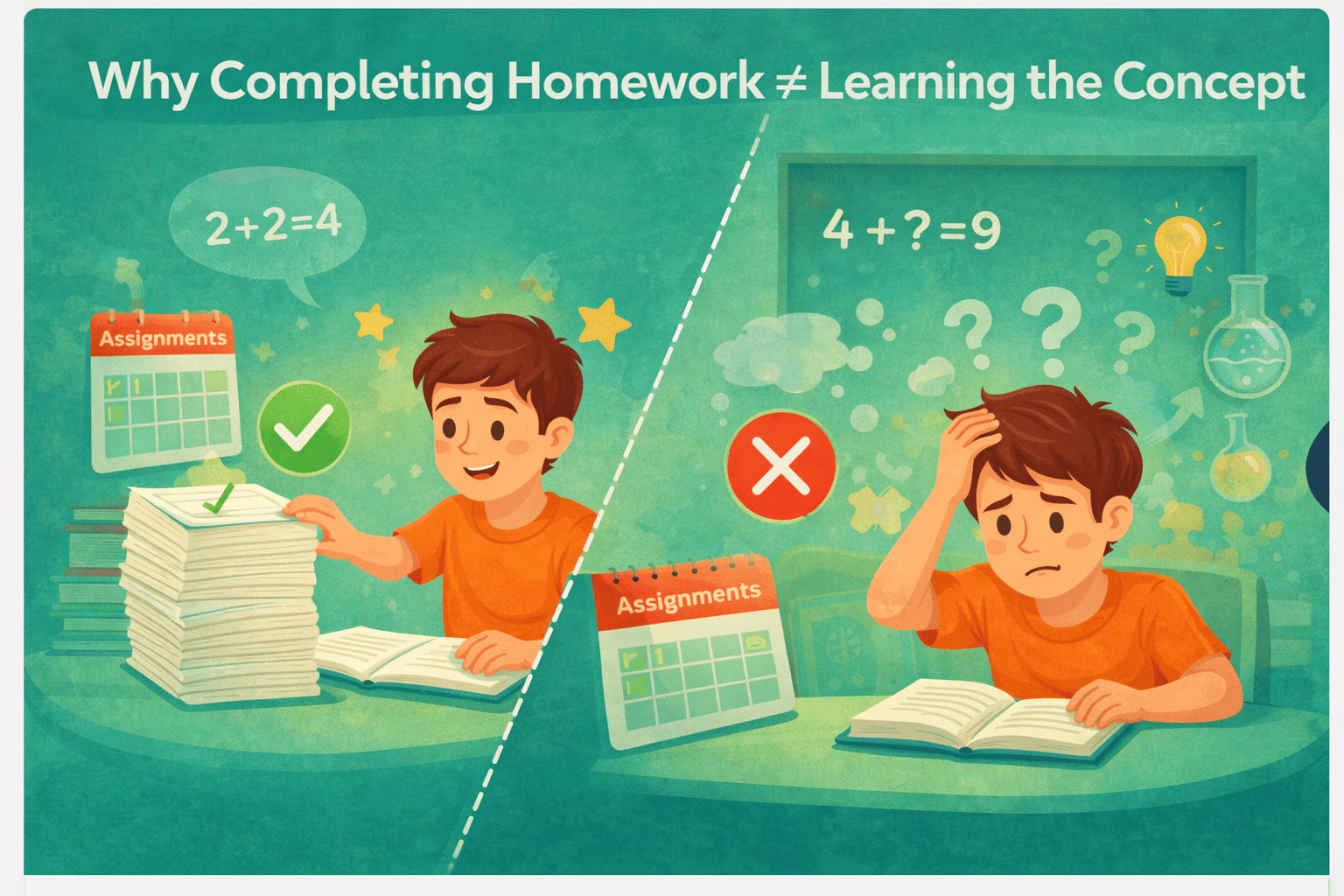
Why Completing Homework ≠ Learning the Concept
Walk into any classroom or tuition centre and the scene feels familiar, almost comforting. Children are seated with open notebooks. Pens are moving. Pages are filling up. From the outside, it looks like learning is happening.
But look closer.
Half the class is copying. A few are racing ahead without understanding why they’re right. Some are already lost but too embarrassed to ask. The teacher explains, solves a few problems, assigns more, and then moves on because the clock demands it. The bell rings. The chapter is “covered.”
What isn’t covered is clarity.
By the time the child goes home, they’re carrying unfinished understanding, borrowed methods, and a growing fear of tomorrow’s homework. The next day repeats the same cycle. They learn how to finish problems, not how to think through them. And when exams finally change the question slightly, everything collapses.
This is how a child can spend years “doing maths” and still fail at it.
What Parents Actually See vs. What’s Really Happening
You see your child sitting with their notebook for two hours.
Homework? Done.
Tuition assignment? Completed.
You feel relieved.
“At least they’re studying.”
But here’s what is going on:
→ They are copying without knowing when to use them
→ They are cramming without grasping the rationale
→ They are hurrying through problems to cut the time taken
→ They are saying “Is this correct?” not “Why does this work?”
I’m not saying your child is lazy. I’m saying the system, including most tuition classes, rewards completion over comprehension.
The Homework Trap Most Tuition Classes Fall Into
Walk into any typical tuition class and you’ll see this scene:
30 children are seated in rows. The tutor talks about a certain matter for 10 minutes, then solves 2–3 problems on the board before announcing, “Now do questions 1 to 20 from your textbook.”
The children get down to work.
Some quickly finish and just stay there.
Others have difficulties but do not ask questions because they are shy.
A few are copying from their neighbors.
The tutor moves around, looks at the notebooks, and marks the problems as “done.”
The class is over.
The homework is “done.”
But has anyone grasped the concept?
No one checked.
This is the reason why the majority of tuition classes are unable to fortify conceptual learning. They function like homework supervision centres, not learning environments.
The Invisible Work of Learning
There is a psychological factor that explains why parents and students feel satisfied when homework is done.
Completion = Visible Progress
You can see filled pages.
You can count solved problems.
It feels like good output.
But the downside is:
→ A child can fill 10 pages without understanding a single concept
→ They can solve 50 problems using the same memorized method
→ They can get the homework “right” by following patterns, not logic
Real learning is invisible. It happens inside the brain when a concept clicks when a student can explain why something works, not just how to solve it.
That is the difference tuition classes need to focus on.
Most don’t.
The Signs Your Child Really Understands a Concept
Forget finishing homework. This is how you can tell real learning has happened:
→ They can explain it to you
Not echo the instructor’s words, but paraphrase it as if they are teaching you.
→ They know when to use it
If they can identify which principle applies in a word problem, that’s understanding. If they need to be told “this is a percentage question,” it’s not.
→ They can handle twisted questions
If they panic when a problem looks different, they learn patterns, not concepts.
→ They ask “why” questions
“Why does this formula work?”
“Is there another way to do this?”
These questions show thinking, not following.
Most tuition classes don’t look for these signs. They stop at homework completion.
What Good Tutors Do Differently
Tutors who build real understanding don’t operate like everyone else.
They don’t care whether homework is done.
They care whether concepts are understood.
This is what that looks like:
→ They ask students to explain solutions, not just show answers
→ They give fewer problems but discuss them deeply
→ They create situations where ideas must be applied
→ They welcome mistakes and treat them as learning moments
→ They check understanding, not completion
At TutorSchool.in, students are paired with tutors based on how they learn, not just the subject they need help with. A tutor who understands your child’s learning style helps them grasp concepts, not just finish homework.
Some students need visual explanations.
Some need step-by-step guidance.
Others need the big picture first.
Good tutors adapt. Homework-only tutors don’t.
How to Identify If Your Child Is Only Getting Homework Help
Ask yourself:
→ Does the tutor ask your child to explain their reasoning or just mark answers right or wrong?
→ Does your child say “I understand it now,” or only “I finished my homework”?
→ Can your child solve problems a week later, or does everything disappear with the next chapter?
→ Does the tutor explain differently for your child, or use one method for everyone?
If tuition is only homework supervision, you’re paying for completion, not education.
What Parents Can Do Right Now
You don’t need to be a subject expert to help your child learn better.
You can:
→ Stop celebrating homework completion
Celebrate understanding instead. Ask, “Can you explain this to me?”
→ Ask tutors better questions
Don’t ask, “Is the homework done?”
Ask, “Do they understand the concept? Can they apply it differently?”
→ Look for concept-first tutors
At TutorSchool.in, AI analyzes learning styles and matches students with tutors who teach accordingly.
→ Let your child make mistakes
Struggle is part of learning. If everything is always correct, the problems are either too easy or being spoon-fed.
The Bottom Line
Homework completion is visible.
Conceptual learning is not.
That’s why most tuition classes focus on homework, it’s fast, measurable, and reassuring.
But your child doesn’t need a homework filler.
They need a concept builder.
One helps with today’s worksheet.
The other prepares them for exams, grades, and real-world problems.
Homework follows understanding.
Understanding never follows homework.
Very Commonly Asked Questions
In what way can I discover if my child really understands or has just memorized?
Ask them to explain the idea in their own words, as if teaching you. If they can’t do it without notes or repeat textbook lines, they’ve memorized it. Give a slightly different problem. If they can’t adapt, it’s memorization, not comprehension.
My child does well in homework but fails exams. Why?
Homework repeats patterns. Exams test application and understanding. If concepts aren’t clear, familiar methods collapse when questions change.
Should I stop caring about homework?
No, shift the focus. Replace “Did you finish?” with “Do you understand?” Homework should reinforce learning, not replace it.
How much time should a tutor spend on one problem?
Quality over quantity. A great tutor may spend 20 minutes on one problem to explain every step and implication. A homework-focused tutor rushes through ten. Speed without understanding is a red flag.
What should I ask a tutor to ensure they focus on concepts?
Ask: “How do you verify my child’s understanding?”
If the answer is only “practice problems” or “homework,” that’s insufficient. Good tutors talk about explanations, applications, and adaptability.
Do online platforms really adapt to learning styles?
Some do. Many don’t. At TutorSchool.in, AI identifies learning preferences and matches tutors accordingly. Compatibility matters as much as subject knowledge.
My child’s tutor says everything is fine because homework is done. Should I worry?
Yes, if that’s the only measure. Ask whether your child can solve unfamiliar problems, justify answers, and retain concepts over time. If completion is the only focus, better tuition is needed.