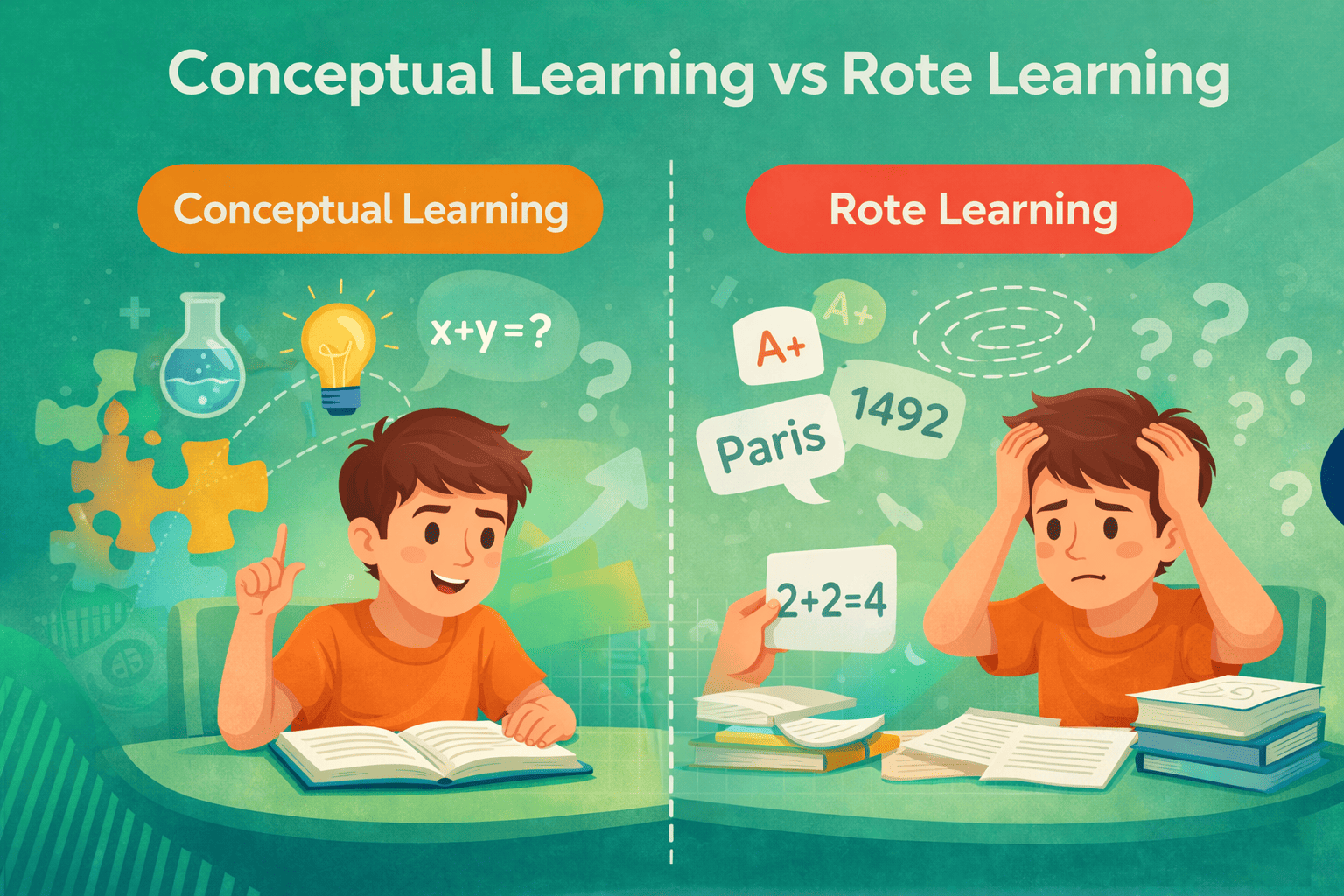
The Real Difference Between Conceptual Learning and Rote Learning
Conceptual learning is all about the “why” and “how,” thus allowing the students to connect their knowledge with the new situation. Rote learning is the straightforward process of memorizing information through constant repetition without comprehending its meaning.
Rote learning has the advantage of quickly recalling facts while conceptual learning fosters the development of problem-solving skills and long-term retention which are the real preparations for the challenges of the real world.
Why This Matters for Your Child
To be straight with you, I am going to give you the uncensored version of the story.
Simply put, the majority of us have been through the same tedious rote memorization learning process. We used to cram formulas just before the exams, forget them one week later, and somehow get by.
But the thing is, this method is no longer effective.
The environment in which your child is raised does not validate rote memorization. There is Google, and there is AI. What really matters in the end is your child’s ability to think rather than just recall.
And that is precisely where conceptual learning would be the solution.
Rote Learning: The Old Way We All Know
How to Define Rote Learning?
To put it bluntly, rote learning refers mostly to the method of memorizing by repetition.
For instance, your kid may read a text 10 times, write it 20 times, and pray that it will be retained for the test.
Rote learning refers to the practice of learning by heart or simply memorizing without understanding.
Here are some typical “examples” of it:
- Multiplication tables are memorized without grasping the underlying concept of multiplication at all.
- Students learn formulas like a² + b² = c² but do not know when or why to apply it.
- Only dates of events are memorized and no understanding of the surrounding circumstances is made.
Language is taught through the rules of grammar, but the actual operation of the language is never made clear.
When Rote Learning Works
Under certain conditions, rote learning may produce results.
Before you think I’m completely against it, rote learning isn’t evil. It is, in fact, quite useful for:
- Learning the alphabet
- Memorizing phone numbers or addresses
- Recalling basic math facts quickly
- Remembering vocabulary in a new language
The problem? Most tuition classes stop here.
They teach your child what to remember, not how to think.
Conceptual Learning: Understanding Over Memorizing
What Is Conceptual Learning?
It is about knowing the “why” behind all the “what.”
No longer just knowing that 5 × 6 = 30, your child comprehends that multiplication is repeated addition. They can picture it. Apply it. Use it in real-life situations.
Here are some instances of conceptual learning:
- Knowing why water boils at 100°C, not just memorizing it
- Being able to explain the process of photosynthesis rather than just knowing the term
- Understanding how grammar rules shape the structure of sentences
- Learning the Pythagorean theorem by recognizing its application to actual triangles
Why Conceptual Learning Is a Game-Changer
The outcome of your child’s conceptual learning is as follows:
→ Longer recall – The comprehension of the concept is much better than just the memory of it
→ Solving problems that are new – They would be able to transfer learning to unfamiliar situations
→ The learning process has become one that they enjoy – When things are clear, curiosity comes up
→ They create a self-assuredness – There are no more “I just can’t do math” times
The Real-World Difference: A Simple Example
I’ll illustrate it to you.
Rote Learning Method:
Teacher: “Formula for area of a rectangle: length times width. You are to memorize this.”
Student memorizes: A = l × w
Exam question: “What is the area of a rectangle with length 5cm and width 3cm?”
Student calculates: 5 × 3 = 15 cm²
Correct answer. Forgets the formula next week.
Conceptual Learning Method:
Teacher: “Let’s take a rectangle and see how many tiny squares we can put inside.”
Student figures out: 5 squares across and 3 squares down makes 15 squares total.
Teacher: “You have just found out the formula! Length times width equals total squares which is area.”
Students get what the area is.
Same exam question? They easily do it.
New problem with an L-shaped room? They can split it into rectangles and calculate.
Can you see the difference?
One method offers a trick, the other gives thinking as a skill.
Why Rote Learning Is the Practice in Most Tuition Classes
Well, to speak frankly.
If the learning by conceptual model is overwhelmingly better, why not all the tutorial classes follow this path? Because it is more challenging.
Rote learning means:
- Fast teaching (just give them a formula)
- Simple testing (did they learn it by heart? Yes or no?)
- Possible with a large group (one teacher, 50 students, the same lecture)
On the other hand, the conceptual learning needs:
- Teaching through theconcept of time consumption per student
- Knowledge of every child’s thinking process
- Giving them the time to struggle and discover
- Teachers who really master the subject
The majority of tuitions operate as a business. First of all, they want to “produce” results quickly. Secondly, they have to accommodate more than 30 kids in one classroom.
Rote learning suits that scenario. Conceptual learning does not fit in there.
It is precisely …
the reason that so many students attending tuition still have problems with the application of what they have learned.
How To Determine If Your Child Is Learning Conceptually
Consider these questions:
Rote Learning Signals:
- Is your child able to solve only those problems that are exactly like the ones from their textbook?
- Do they get scared when a question has a different wording?
- Is the child repeatedly saying “Which formula do I use here?”
- Is everything forgotten already after the exam?
Conceptual Learning Signs:
- Is your child willing to explain not just what but also why the answer is that way?
- Are they connecting topics across different subjects?
- Can they tackle completely new problems?
- Are they inquisitive and proposing “what if” scenarios?
What Parents Can Do Right Now
You don’t need to be a teacher in order to support conceptual learning.
What actually helps is the following:
→ Ask “why” and “how” questions
Instead of “What’s the answer?” ask “How did you work that out?”
→ Allow them to struggle (a little)
Do not raise your hand with the answer right away. Let them ponder.
→ Link learning to daily life
Cooking? That is fractions and chemistry. Shopping? That is percentages and budgeting.
→ Pick the tutors who instill the understanding
Ask the tutors you consider: “How do you make students grasp ideas, not just memorize?”
TutorSchool pairs pupils with tutors according to their learning preferences. A visual learner has to be dealt with differently from a step-by-step learner.
That is how true conceptual learning occurs when teaching is aligned with how your kid’s brain really functions.
The Bottom Line
Memorization learning gets your kid through the exam.
Conceptual learning gets them through the whole life.
Your kid does not need to memorize more; they need to comprehend well.
And a good tutor, the one who concentrates on how your child learns rather than on what scores he/she needs to get, will make a huge difference.
Are you looking for a tutor who teaches conceptually and not just exam tricks?
At TutorSchool, we are developing AI that is able to differentiate between how the students learn best and then connect them with tutors that foster that learning. Come and see how we personalize learning through our method.
FAQs
1. Is rote learning ever necessary?
In some cases, yes! Basic facts like multiplication tables, alphabet and vocabulary must be repeated. Nevertheless, this method shouldn’t be the only one for complex subjects.
2. Can older students move from rote to conceptual learning?
Of course! It needs time and patience, but students of any age with the right support can learn to think conceptually.
3. How can I tell my child’s tutor emphasizes conceptual learning?
Request an explanation of their teaching method. A tutor worth his/her salt will refer to building understanding, asking questions and helping students to connect ideas, not just going through the syllabus.
4. Is conceptual learning time-consuming?
At first, yes. But students remember the material longer and can thus apply it faster, so it is actually time-saving in the long run.
5. Will conceptual learning contribute to better board exam scores?
Definitely! Students who comprehend concepts at a deeper level outperform their peers in both standard and application-based questions that modern exams increasingly include.